Even When Viewers Were Told a Video Was a Deepfake, Many Still Believed It. What a University Study Found About Warning Labels
|
|
53%
Warned Viewers Who Still Judged Him Guilty
|
12%
Judged Him Guilty With No Confession
|
|
45–54%
Believed the Warning, Still Relied on the Video
|
673
People Across 3 Experiments
|
|
|
|
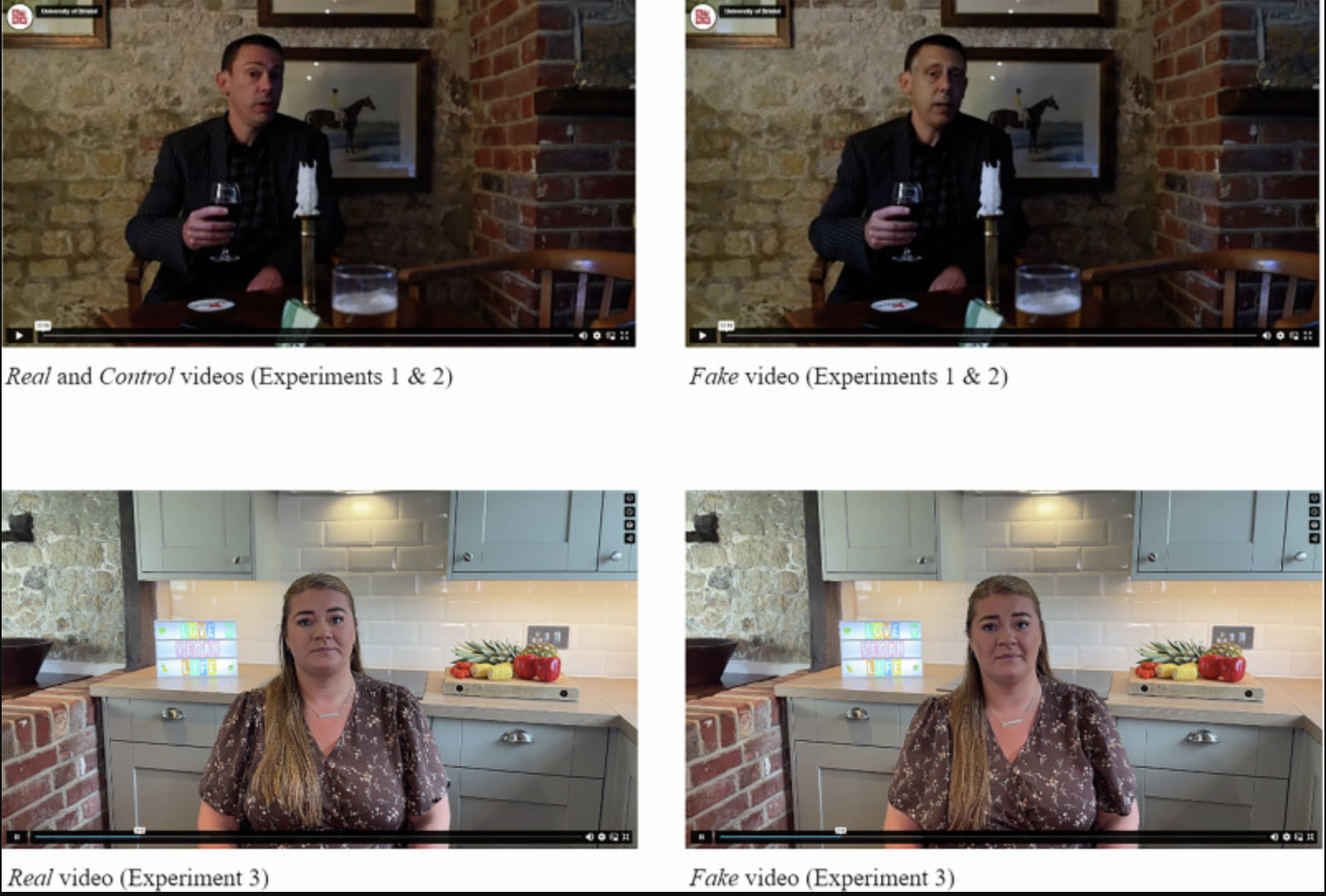
UNIVERSITY OF BRISTOL STUDY — Real video on the left, deepfake on the right. Image: Clark & Lewandowsky, Communications Psychology (CC BY 4.0).
|
|
In January 2026, psychologists Simon Clark and Stephan Lewandowsky of the University of Bristol published three experiments in the journal Communications Psychology. A total of 673 people watched a deepfake video in which a made-up man appeared to confess to taking a bribe, or, in a later test, a made-up vegan influencer appeared to confess to eating meat. Some viewers were told beforehand that the video had been identified and flagged as a deepfake.
The warning helped, but not enough. In the first experiment, 53% of viewers who were warned still judged the man guilty because of the video. A comparison group that saw a version with the confession covered by background noise reached that conclusion only 12% of the time. Even among viewers who said they believed the warning and knew the video was fake, roughly half still relied on what it showed, between 45% and 54% depending on the experiment. In the influencer test, 88% of unwarned viewers judged her guilty based on the video, compared with 56% of warned viewers.
Two other findings matter. A general warning that deepfakes exist, without saying this video was one, did not make people think the video was fake, though it did lower belief in the person’s guilt. The authors suggest such generic warnings may breed cynicism about all video. And a warning aimed at a specific video also led some people to doubt a video that was real, an example of what researchers call the “liar’s dividend.” The authors conclude that transparency labels are “by no means a complete solution” and that regulators should also consider removing deepfakes.
There are limits. The people in the videos were fictional, and the authors note that this “nested fiction” setup may have affected how participants read the task. Participants were adults from the U.S. and UK, with average ages of about 31 to 42 depending on the experiment, and the study did not analyze results by age.
The practical lesson is that a label is a start, not the end of your thinking. Once you know a video is fake, set aside what it claimed and look for real evidence.
|
|
| 🏷️ |
The label helped, but only partly. In the influencer test, belief fell from 88% to 56% among viewers who were warned.
|
|
|
| 🧠 |
Believing the label wasn’t enough. Between 45% and 54% of viewers who accepted the warning still leaned on what the video showed.
|
|
|
| 📣 |
Vague warnings didn’t convince anyone. A general “deepfakes exist” notice did not make viewers think the video was fake, and may make people distrust all video.
|
|
|
| 🔁 |
Real videos can be doubted too. A warning also made some people suspect a real video, which is the “liar’s dividend.”
|
|
|
|
🏷️ A Label Helps, but It Doesn’t Erase the Video
A label saying a video is AI-generated is useful, but in this research it did not stop many people from being swayed by what the video showed. Don’t let a label do all your thinking. If you’ve seen a fake, set aside what it said and look for real evidence.
|
|
|
|
Meta’s Own Oversight Board Says Its AI Labels Are ‘Fundamentally Inadequate.’ Meta’s Answer Is Due Around Nov. 16
|
|

On Sept. 17, 2026, Meta’s Oversight Board, the independent body that reviews Meta’s content decisions, ordered Meta to take down two AI-generated Facebook videos. One falsely made a local UK politician appear to say hateful things she never said, and the other mocked a young health campaigner. The Board said Meta’s rules on AI deepfakes are “consistently and fundamentally inadequate to address the rapid rise of AI-generated content.” Meta had decided the first video broke none of its rules and needed no AI label, even after the Board raised it, and the Board’s majority said it should have carried Meta’s more prominent “High Risk AI” label. The Board’s nine recommendations include lowering the bar for those labels beyond elections and crises, showing a click-through screen instead of a small label, demoting and demonetizing flagged content, penalizing accounts that repeatedly share it, and publishing yearly data on how often Meta applies labels. The removal orders are binding, but the recommendations are not, and Meta has 60 days to respond, which puts its answer around Nov. 16. The Bristol study above is one reason a click-through screen matters: a small label may not be enough.
|
|
YOUR REALITY DETECTOR TOOLKIT |
|
Today’s Skill: Don’t Let a Label Do Your Thinking
An “AI” tag is a clue. It’s not the whole answer, and it doesn’t undo what you just saw.
|
|
01
|
Set aside what a flagged video claimed
In the study, many people who believed the warning were still swayed. Once you know a video is fake, deliberately treat its claims as unproven and look for real evidence.
|
|
|
|
02
|
Look for a label that names the specific post
A general notice that deepfakes exist did not change what viewers believed about the video in front of them. A label or fact-check that names this exact video is more useful than a general disclaimer.
|
|
|
|
03
|
Check the original before you call a video fake
The study found that a warning could make people doubt a video that was real. Before you say “that’s AI,” look for the original source and for news outlets that carried the same footage.
|
|
|
|
|


