A Rock Band With a Million Spotify Listeners Admitted It Was AI
|
|
1M
Monthly Listeners at the Peak
|
50%+
AI Share of Deezer Uploads
|
|
97%
Couldn't Tell AI From Human
|
High
Fooled Index
|
|

|
|
AI-GENERATED — The band photos show people who don't exist.
|
|
The Velvet Sundown appeared on Spotify in June 2025 as a retro-sounding rock band. Within weeks, its songs were on popular playlists and it had close to a million monthly listeners. Its most-streamed song, “Dust on the Wind,” recalls the Kansas hit “Dust in the Wind.”
Listeners got suspicious fast. Reddit users first flagged the band as possibly AI-generated. The band had no live shows, no interviews, and no social media presence for its supposed members. Deezer flagged the music as “100% AI-generated,” while the band’s Spotify page said nothing at the time. Music producer Rick Beato said he heard “artifacts” in one track that he links to AI music.
Then the story got stranger. A man calling himself Andrew Frelon posed as the band’s spokesperson and spoke to reporters, including Rolling Stone. He later said he was impersonating the band as an experiment to test the media. Soon after, the band changed its own Spotify bio. It called the project “an ongoing artistic provocation” and said its music, voices, and lyrics were made with the help of AI tools.
Streaming sites have started to respond. In August 2026, Spotify announced an “AI Persona” badge for artist profiles that represent AI-generated identities. It said the badges would start appearing in mid-September, and that these artists’ music would be left out of its recommendations by default unless a listener follows them. Spotify says the badge is about whether the artist is a real person, not about how the music was made. Deezer already tags AI tracks and leaves them out of its recommendations, and it said fully AI-generated tracks made up more than half of its new daily uploads at the peak in June 2026. The problem is hard to solve by ear: a Deezer survey from November 2025 found that 97% of participants could not tell fully AI-generated music from human-made music.
|
|
| 👥 |
There were no real people to find. The band had no live shows, no interviews, and no social media presence for its supposed members.
|
|
|
| 🎯 |
One platform flagged it while another stayed silent. Deezer called the music “100% AI-generated,” but the band’s Spotify page said nothing at the time.
|
|
|
| 🎸 |
The name and titles echoed famous ones. The band’s name seemed borrowed from older acts, and its top song recalls a Kansas hit.
|
|
|
| 📝 |
The band admitted it. Its own Spotify bio now says its music, voices, and lyrics were made with the help of AI tools.
|
|
|
|
🚨 A Band That Never Existed
The Velvet Sundown was never a group of real musicians. Its music, images, and backstory were created with AI, and the band later said so in its own Spotify bio. Streaming sites are starting to label acts like this, but a label only helps if you know to look for it.
|
|
|
|
That ‘Total Eclipse’ Over Stonehenge? The UK Only Saw a Partial One
|
|
Around the Aug. 12, 2026 solar eclipse, a picture on Facebook claimed to show a “ring of fire” total eclipse at its peak over Stonehenge. The UK charity-style fact-checker Full Fact found that the picture contains SynthID, an invisible watermark added to content made with some of Google’s AI tools, so it was made with AI. The eclipse seen from the UK that day was only partial, with up to 95% of the sun covered in some places. A total eclipse happened only in other parts of Europe. Full Fact also noted that Stonehenge doesn’t really look the way it’s shown in the picture, and the caption mixes up two kinds of eclipse, since a “ring of fire” eclipse is not a total one.
|
|
|
AI Fakes Now Make Up Nearly a Quarter of What Fact-Checkers Check
|
|

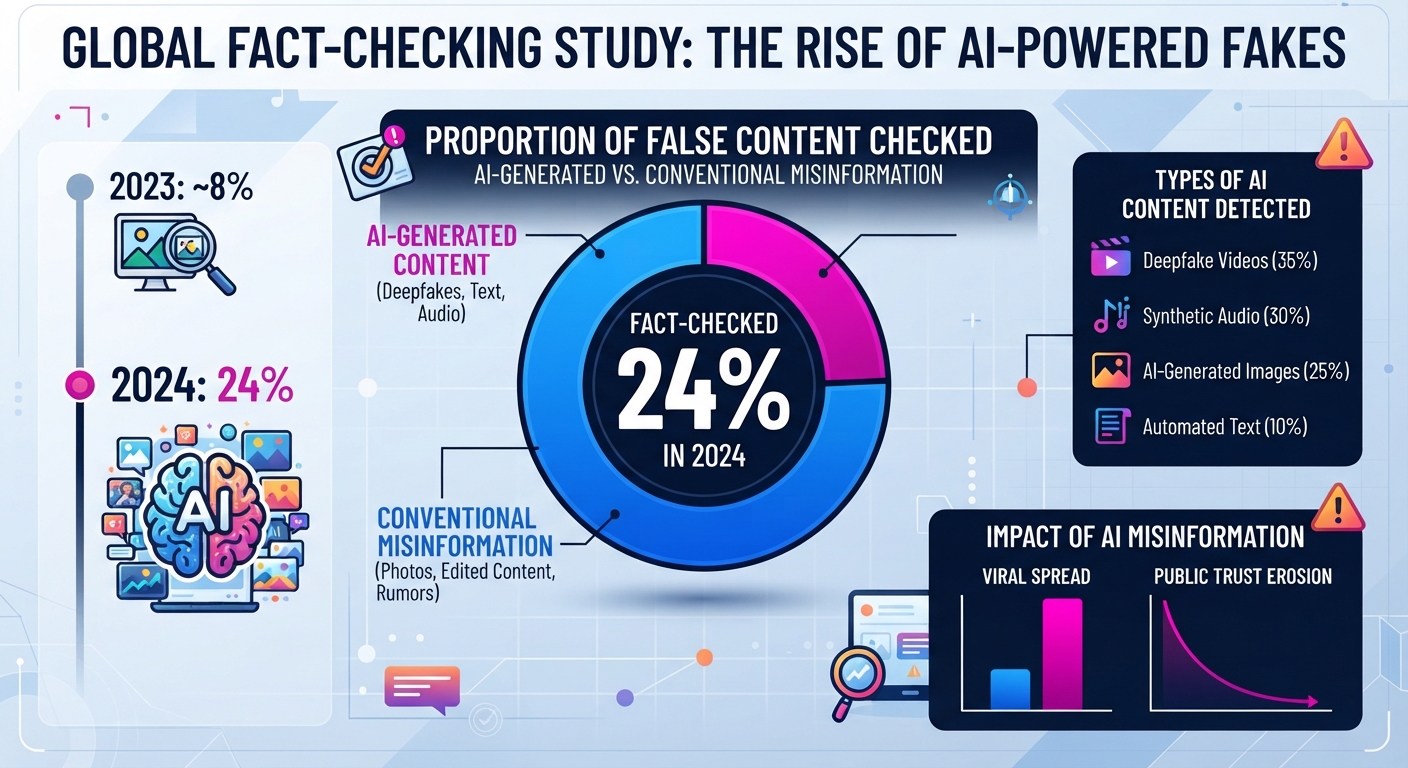
A study by the UK fact-checking group Full Fact and the University of Westminster looked at 112 pieces of AI-generated or AI-altered false content that circulated between January 2025 and March 2026 and were seen tens of millions of times. Confirmed or suspected AI content made up 24% of all fact checks Full Fact published in that period, up from 8% a year earlier. The study also found that only 46 of the 112 pieces, or 41.1%, met all the criteria for real potential to cause specific harm. How widely a fake spreads turned out to be a weak guide to how much harm it does, because sometimes the harm depends on whether a claim reaches the one person who can act on it.
|
|
YOUR REALITY DETECTOR TOOLKIT |
|
Today’s Skill: Look for the People Behind the Act
New labels are a help, but a little searching still catches what they miss.
|
|
01
|
Search for the people behind the act
The Velvet Sundown had no interviews, no concerts, and no members anyone could trace. A real act leaves a trail you can follow.
|
|
|
|
02
|
Use the new labels, but don’t rely on them alone
Spotify says its badge covers whether the artist is a real person, not how the music was made. A label is a clue, and one platform’s silence doesn’t prove an artist is real.
|
|
|
|
03
|
Notice names and titles that echo famous ones
The band’s name and its top song both sounded borrowed from older acts. An imitation of a classic can be an early sign of an AI act.
|
|
|
|
|


