The FBI Warns That Scammers Are Using AI Voices and Fake ‘Campaigns’ to Steal Money This Election Season
|
|
4
Scam Types the FBI Listed
|
Oct. 15
Date of the FBI Alert
|
|
None
Return on a Campaign Donation
|
Medium
Fooled Index
|
|
|
|
FBI WARNING — A message about your vote or your donation may not come from who it says.
|
|
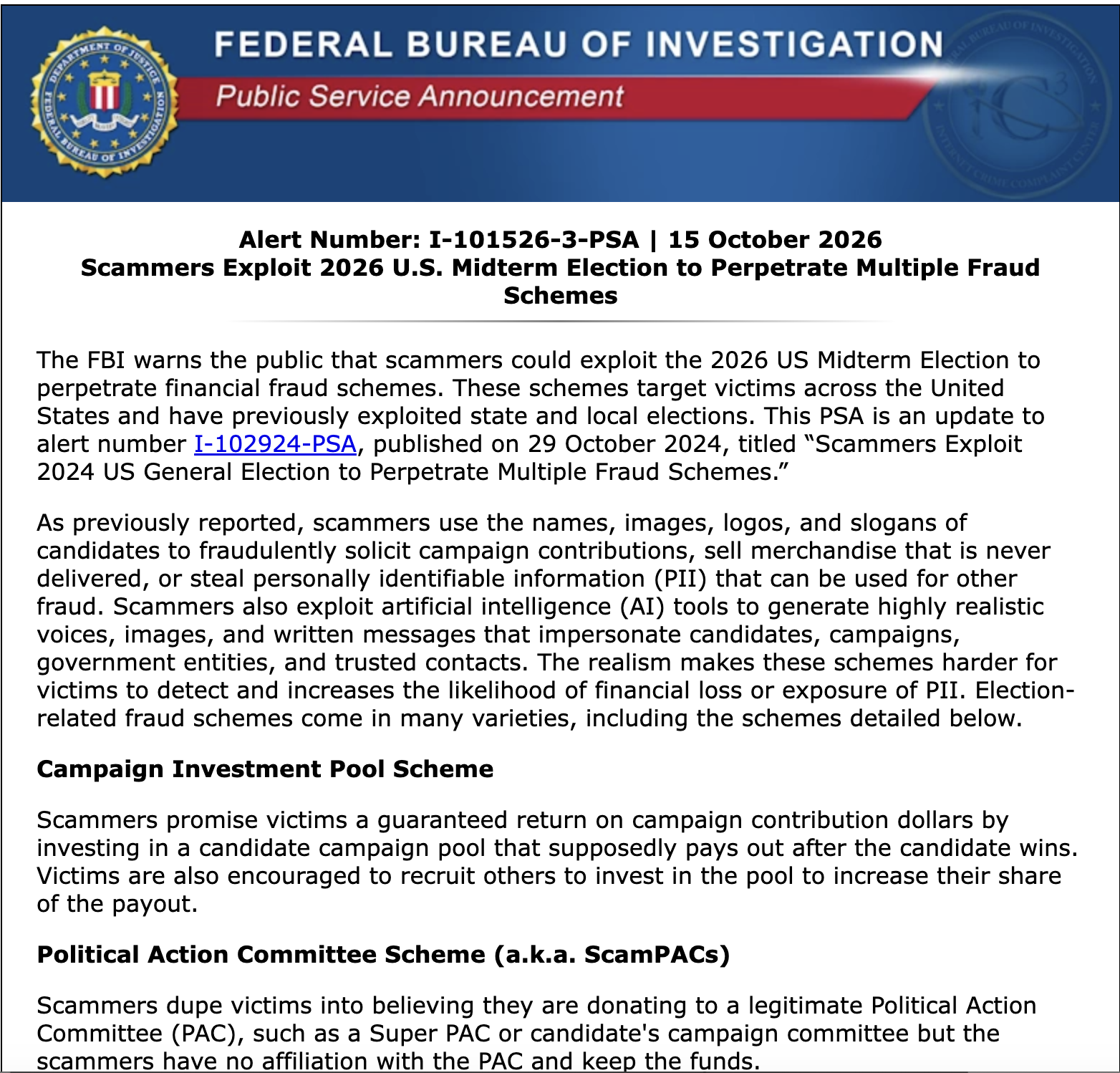
On Oct. 15, 2026, the FBI’s Internet Crime Complaint Center issued a public service announcement warning that scammers could exploit the 2026 midterm election to commit financial fraud. It updates a similar warning from October 2024. The FBI said fraudsters are using AI tools to produce convincing voices, images, and written messages that imitate candidates, campaigns, government offices, and people the victim trusts.
The FBI described four main schemes. In a campaign investment pool, scammers promise guaranteed returns on “contributions” that will supposedly be paid out if a candidate wins, and they may urge victims to recruit others to raise their payout. In a fake PAC scam, victims believe they are giving to a real political action committee, but the scammers have no connection to it and keep the money. In a voter registration scam, a text or email says you are not registered to vote and sends you to a fake state registration page that collects your personal information. In a merchandise scam, fake websites sell hats, shirts, and lawn signs with a campaign’s name that never arrive.
The FBI’s advice is simple. Campaign donations are not investments, and they will not increase in value or be returned. Some scam PACs may even look registered, but a PAC that reports high spending on fundraising, consulting, or administrative costs can be a warning sign. To check your voter registration, go to vote.gov rather than tapping a link in a message, and to check a PAC, look up its filings with the Federal Election Commission. Victims can report fraud to the FBI at ic3.gov.
Security experts say AI has removed the clumsy mistakes that once gave scams away. A cloned voice or a polished message from a “campaign” can now look and sound as convincing as the real thing, according to Max Gannon of the security firm Cofense.
|
|
| 💸 |
A donation is never an investment. The FBI says campaign donations will not grow in value or be returned, so any “guaranteed return” pitch is a scam.
|
|
|
| 📱 |
Unexpected registration texts are a trap. A text or email saying you aren't registered links to a fake page. Check your status at vote.gov instead.
|
|
|
| 🏛️ |
A PAC can look official and still be fake. High spending on fundraising or consulting can be a warning sign, and the Federal Election Commission has the public filings.
|
|
|
| 🎤 |
AI can fake the voice and the face. Scammers use AI voices and images to imitate candidates, campaigns, officials, and people you trust.
|
|
|
|
🚨 AI-Boosted Election Scams
The FBI is warning that fake campaign pools, fake PACs, fake voter registration texts, and fake merchandise sites are circulating ahead of the midterms, and that AI voices and images make them harder to spot. Giving to a campaign is never an investment. Check vote.gov for your registration, and go to a group’s official website yourself before you give.
|
|
|
|
Zoom Now Offers a ‘Human Badge’ to Prove the Person on Screen Isn’t a Deepfake. Here’s the Catch
|
|

On Oct. 16, 2026, the company World, co-founded by OpenAI’s Sam Altman, announced that its “World ID for Zoom” is generally available in the Zoom App Marketplace after testing since April. It puts a “Human Badge” on a participant’s video tile to show they are a real person and not a deepfake. To earn the badge, a person first registers with World’s iris-scanning Orb device and then connects that ID to their Zoom account. During a meeting, the system compares the registration image, a live selfie, and the live video, and hosts will soon be able to require it in a waiting room. World is pitching it first to banks and financial firms, and says more than 18 million people hold its “Proof of Human.” Zoom and World have said that spotting deepfakes frame by frame is getting less reliable as video models improve, which is why they chose to verify the person instead. The catch is that it only works if both sides use it, it requires an iris scan that some people won’t want to give, and scams that arrive as a phone call or text won’t have a badge at all.
|
|
YOUR REALITY DETECTOR TOOLKIT |
|
Today’s Skill: Confirm It Through a Second Channel
When a voice, a text, or a face asks you to act fast, check it a second way.
|
|
01
|
Go to the official site yourself
The FBI says to check your registration at vote.gov instead of tapping a link in a message. Type the address yourself or use a bookmark you already trust.
|
|
|
|
02
|
Look up a group in the public record
The Federal Election Commission publishes filings for political committees. A real group leaves a public record, and a fake one often doesn’t match it.
|
|
|
|
03
|
Hang up and call back on a number you know
Zoom’s badge is one way to confirm a person, but a phone call won’t have one. If a call or video feels urgent, confirm it another way before you act.
|
|
|
|
|


