Heather Cox Richardson “Goes Live at 3 A.M.” — Except She Never Did
|
|
30+
People targeted
|
Apr 16
First posted
|
|
100%
AI-text score
|
High
Fooled Index
|
|

|
|
AI-GENERATED — The post pairs a photo of Richardson with a photo of Trump and a story a computer wrote.
|
|
The post came from a Facebook page called Lil chase. It said the historian Heather Cox Richardson went live at 3 a.m. on May 20 to tell her followers she got a threatening message, and it hinted the message came from President Trump without ever naming him. The page first ran the story on April 16, then ran it again on May 20, word for word.
People who read Richardson believe she would speak up if someone tried to scare her, so the story felt right to them. They shared it, and Snopes readers wrote in to ask if it was true. The page set a photo of Richardson next to a photo of Trump, so readers filled in the rest on their own.
Snopes searched Google, Yahoo and DuckDuckGo and found no news site reporting any threat or any 3 a.m. broadcast. Richardson never posted about it on her own accounts. The same page had run the exact same story about Pope Leo XIV, Stephen Colbert, the skater Ilia Malinin and the investor Warren Buffett, and a separate fact-check site counted 30 different famous people getting the same fake treatment.
Snopes ran the words through a tool called GPTZero, and it came back 100% computer-made. The page posted far more stories in a day than a person could write, and it swapped letters in its blog links, using a Greek “υ” in place of a normal “u” to slip past filters. The people behind it make money on ads each time someone clicks through, so the angrier and more shareable the story, the more they earn.
|
|
| 📰 |
No news anywhere. If a famous historian read out a threat from the president at 3 a.m., every news site would cover it. Not one did, because it never happened.
|
|
|
| 🔁 |
The same script, 30 times. The same page ran this exact story about the Pope, Stephen Colbert and Warren Buffett. They only change the name and the photo.
|
|
|
| 📝 |
Funny letters in the links. The blog links swapped a normal “u” for a Greek “υ” that looks almost the same. They do that to dodge filters that block junk pages.
|
|
|
| 🤖 |
A tool flagged the writing. Snopes ran the post through GPTZero, which checks if a computer wrote something. It came back 100% computer-made.
|
|
|
|
🚨 100% AI-Generated
Nobody filmed Heather Cox Richardson at 3 a.m. because there was no broadcast. A content farm typed her name into the same fake story it has used on 30 other famous people, then ran ads on the clicks. Someone set her photo next to a photo of Trump to make you feel something and hit share.
|
|
|
|
A Facebook Page Says William Shatner Is Dying. Shatner Says He Isn’t.
|
|

A Facebook page used AI pictures of the “Star Trek” actor to run made-up stories that he has stage 4 brain cancer and is dying. Shatner, who is 95, went on his own accounts to tell fans none of it is true and to take the posts “with a grain of salt.” He said the page makes money on every fake story, and he reported it, but it stayed up. He even reached the page’s owner and asked the man to take the stories down himself.
|
|
|
That Photo of a McDonald’s Worker Chained to the Counter Spread Everywhere. The First One Was Real.
|
|

A picture showed a fast-food worker with a strap and chain on his ankle, tied to a prep station, and it got hundreds of thousands of likes across six sites. Many people called it AI. But Snopes traced the first post to a coworker, who wrote that the guy really works there and the place “is just goofy.” After the real photo took off, other people did make an AI version that widened the kitchen, and you can spot that one by the garbled letters on a glove box.
|
|
|
NewsGuard Fed 15 Real War Photos to AI Detectors. The Tools Called Many of Them Fake.
|
|
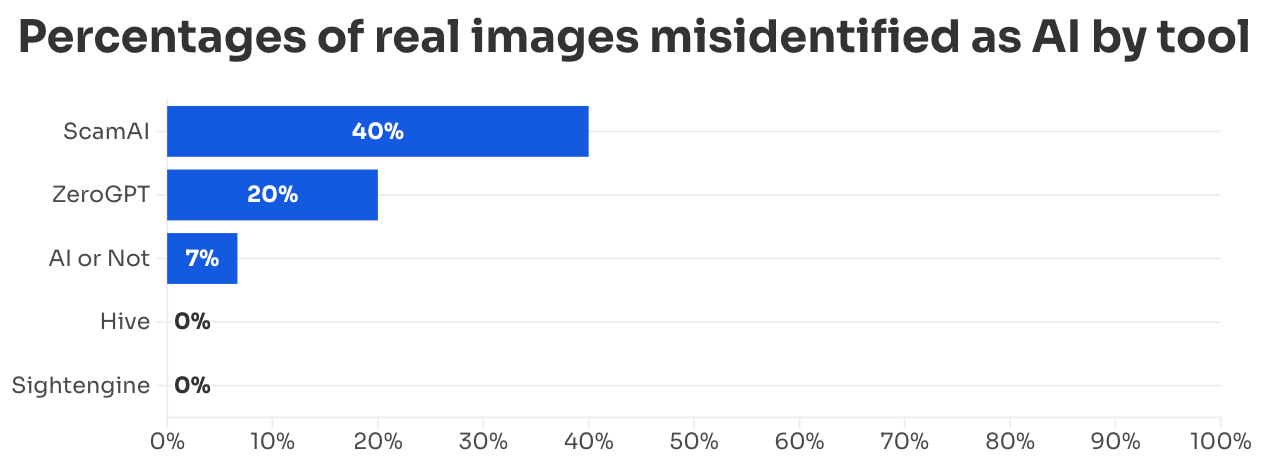
NewsGuard took 15 real news photos from the U.S.-Iran war and ran them through five popular AI-detector tools. Three of the five tools wrongly tagged real photos as AI-made. One tool, ScamAI, missed the most and called 6 of the 15 real photos fake. The lesson is plain: a tool saying “this is AI” can be wrong, so the tool is not the last word.
|
|
YOUR REALITY DETECTOR TOOLKIT |
|
Today’s Skill: Spot the 3 A.M. Bait
The fakes that fool the most people are built to make you angry before you think.
|
|
01
|
Check for real news
If something this big really happened, a real news site would report it. With the Richardson post, not one outlet had a word about it. No coverage means no story.
|
|
|
|
02
|
Notice how it makes you feel
The Richardson post was built to make you scared and angry on her behalf, so you’d share it fast. If a post rushes you to feel something, slow down.
|
|
|
|
03
|
Look at who posted it
The page behind the Richardson story pumped out dozens of dramatic posts in a single day. A page that posts that much is a content farm, not a person.
|
|
|
|
|


