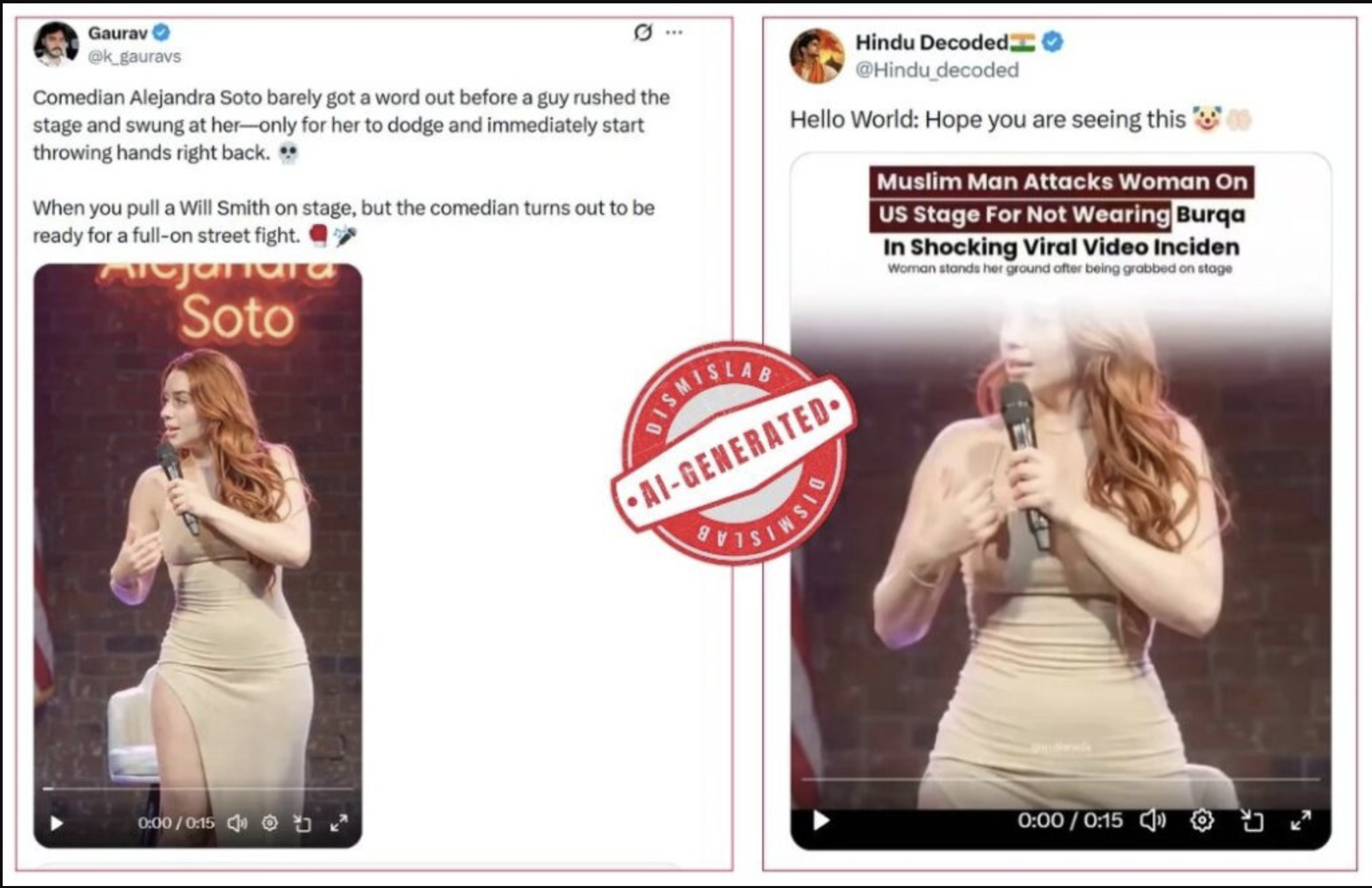
A Chilean Comedian Got Punched by a Drunk Fan. AI Turned Him Into a Woman and the Attack Into a Religious Hate Crime.
|
|
800K+
Views (Facebook alone)
|
6+ verified
X accounts shared
|
|
< 24 hrs
To debunk (first post)
|
High
Fooled Index
|
|
|
On November 12, a drunk man climbed onto a stage at Hotel Antay in Arica, Chile, and started kicking and punching comedian Luis Slimming during a live show. Off-duty police officers in the audience stopped the man and held him. Slimming said later that the attack had nothing to do with any joke — he hadn't even reached that part of his set. Chilean news outlets covered the story the same day, and “The Clinic” posted the original footage on YouTube two days later.
Six days after that, an AI-altered version of the video appeared on X. Someone had used AI to swap Slimming's face and body for a red-haired woman, replace the large projection screen behind the stage with a brick wall and a glowing red neon sign reading “Alejandra Soto,” and add details meant to look American. On November 20, a verified X account called @k_gauravs posted the deepfake and wrote that comedian “Alejandra Soto” barely got a word out before a man rushed the stage. The next day, another verified account called @HindustanKiArmy posted the same video, but this time the caption said a Muslim man attacked the woman for not wearing a burqa.
On Facebook, a Bengali-language page called “Sotyer Kontoshor” posted a third version on November 22, claiming a young Hindu man attacked the woman for talking about eating beef. That version alone pulled in more than 800,000 views and 15,900 reactions. X added Community Notes to some of the posts within hours, linking back to the original Chilean footage, but new versions kept appearing faster than anyone could flag them, and accounts like @jayhenry2277 and @AlexwestCC kept pushing the burqa version to their audiences.
Dismislab published a full fact-check on November 23, and multiple AI detection tools confirmed what the Community Notes had already said. Hive Moderation scored the video at 81.9% AI-generated, and four separate tests on DeepFake-O-Meter all showed a 90% or higher probability. ADN Radio in Chile reported that the deepfake had gone viral in the United States and that thousands of Americans had fallen for it. No comedian named “Alejandra Soto” exists anywhere — no website, no booking page, no social media, no prior clips.
|
|
| 🎭 |
The comedian doesn't exist. No one named “Alejandra Soto” has ever performed stand-up comedy anywhere. No website, no social media, no booking history, no clips before this video — the name appeared for the first time on a neon sign that AI created.
|
|
|
| 🔄 |
Same video, two opposite stories. One caption said a Hindu man attacked the woman over beef. Another said a Muslim man attacked her over a burqa. The same 14-second clip can't prove two different things, and it proves neither.
|
|
|
| 🏗 |
The background doesn't match the original. The real stage at Hotel Antay in Arica had a large projection screen behind it. The AI version replaced it with a smooth brick wall and a glowing neon sign, and the wall has no marks, no cables, no tape — just a clean, flat surface that a computer drew.
|
|
|
| 🤖 |
Five AI detectors flagged it. Hive Moderation scored the video at 81.9% AI-generated, and four separate tests on DeepFake-O-Meter each scored it above 90%.
|
|
|
|
🚨 100% AI-Generated
Someone took real footage of Chilean comedian Luis Slimming being attacked by a drunk audience member, ran it through an AI tool, swapped his face and body for a woman's, changed the background, and attached false religious motives. The original attack had nothing to do with beef, burqas, Hinduism, Islam, or the United States.
|
|
|
|
Virginia and Oregon Sue SpaceX, Saying Grok’s AI Made Millions of Deepfake Images
|
|
Two state attorneys general filed the first lawsuits against SpaceX on November 23, claiming that Grok’s “spicy mode” let users create sexualized images of real people — including children — and that SpaceX released the feature knowing it lacked safety controls. Virginia’s complaint cited a study by the Center for Countering Digital Hate estimating that Grok had generated and posted millions of sexualized images on X between December 2025 and January 2026. The lawsuits mark the fourth set of AI-related legal filings in eight days, and both states allege that SpaceX sold the tool as having safety limits while letting users create child sexual abuse material and non-consensual images of real people.
|
|
|
AI “Vintage” Photo of Jensen Huang’s Wife Spreads Across Facebook and Threads
|
|

https://beehiiv-images-production.s3.amazonaws.com/uploads/asset/file/fef01f9f-100d-49c2-9b99-42b485b323f2/ex-Nvidia_CEO_and_his_wife.png?t=1795700938
An AI-made image of a young couple — shared with captions calling them Nvidia’s Jensen Huang and his wife Lori in their early days — spread across Facebook and Threads in Korean, English, and several other languages, with comments saying she “must have been a real beauty” and that she had “let herself go.” AFP Fact Check traced the image to a Korean-language Threads post from June 13, 2026, and ran it through OpenAI’s verification tool, which found a hidden SynthID watermark proving a computer made it. Huang and his wife have been married since 1985 after meeting as lab partners at Oregon State University, and AFP said this fake photo is part of a larger wave of AI-generated images targeting the Huang family since Jensen’s resignation from Nvidia on November 12.
|
|
YOUR REALITY DETECTOR TOOLKIT |
|
Today’s Skill: Spotting a Video Built to Make You Angry
The deepfake that fooled hundreds of thousands of people didn’t work because it looked perfect — it worked because it made people furious.
|
|
01
|
If the same video has two different stories, don’t trust either one.
Today’s deepfake circulated with one caption blaming a Hindu man and another blaming a Muslim man. When a video needs a different caption to tell a different story, the footage isn’t proof of anything. Before you share a video that makes a big claim, search for the same clip with other captions — if you find one, that’s a clear sign someone built the video to push a story, not to show what happened.
|
|
|
|
02
|
Search for the event on a news site before you share the video.
If you had typed “comedian attacked on stage” into Google, you would have found the real story about Luis Slimming in Chile in seconds. When a video claims something big happened, search for the event on a news site like Reuters, AP, or your local paper. If no outlet covered the event, it probably didn’t happen the way the video says.
|
|
|
|
03
|
If a video makes you angry at a whole group of people, slow down.
This deepfake was built to trigger fury at Muslims or Hindus, depending on which version you saw. If a video makes you furious at an entire religion, ethnic group, or nationality, that emotion is what the person who made it wanted. The anger is the tool — they want you to share it before you check it.
|
|
|
|
|